

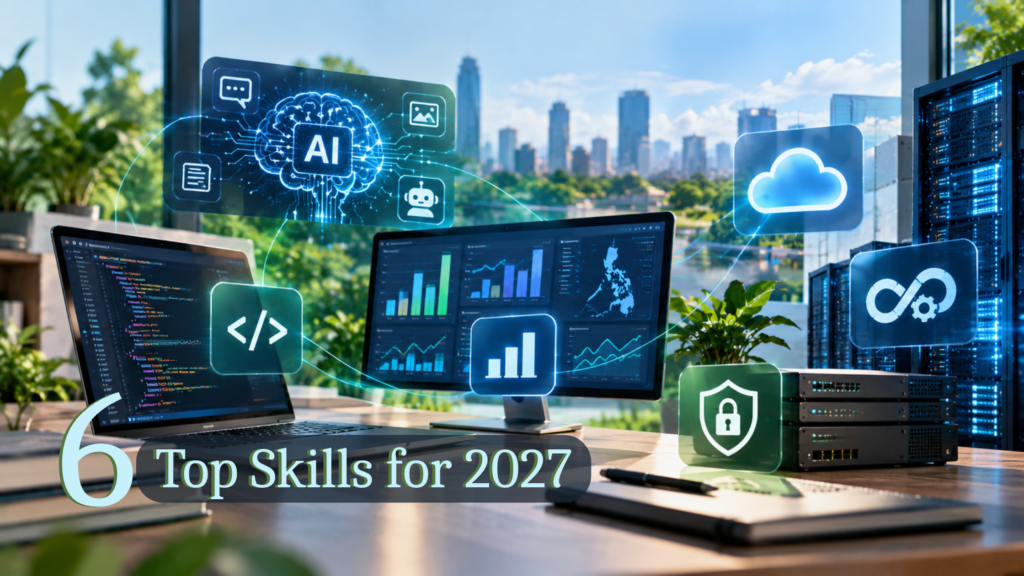
2027 is only a few sleeps away and organizations are expected to integrate Artificial Intelligence into daily operations, automate repetitive workflows, strengthen cybersecurity, analyze data in real time, and build cloud-native applications that can adapt to rapidly changing business needs.
Technology has become the foundation of modern business. Organizations are no longer competing only through products and services. They compete through innovation, speed, customer experience, data-driven decision-making, and operational excellence. In the vast sea of skills one can learn to keep up with the industry today, it can be challenging to pick a number of skills to upskill yourself with. That is why, below, I listed top skills individuals and companies should master to get ahead in 2027.
The Top Technical Skills Companies Should Master Before 2027
1. Artificial Intelligence (AI), Generative AI, and Agentic AI
Organizations must learn how to leverage AI to automate tasks, generate content, support decision-making, and deploy intelligent AI agents that can execute complex workflows with minimal human intervention.
Course: The Complete AI Guide: Learn ChatGPT, Generative AI, & More
Duration: 3 Days (21 Hours)
Introduces the fundamentals of Generative AI and ChatGPT, teaching participants how to create effective prompts, generate high-quality content, automate everyday tasks, and apply AI across different business functions.
Key Learning Objectives:
- Understand the fundamentals of Generative AI, large language models, and ChatGPT, including their capabilities, limitations, and practical applications in modern workplaces.
- Develop effective prompt engineering techniques to generate accurate, relevant, and high-quality responses for writing, research, business communication, and problem-solving tasks.
- Apply ChatGPT to automate content creation, document drafting, summarization, brainstorming, and other productivity-focused business processes across various industries.
- Evaluate and refine AI-generated outputs while applying responsible AI practices, including ethical considerations, security awareness, and information validation.
- Build practical AI workflows by integrating ChatGPT into everyday business activities to improve efficiency, collaboration, creativity, and decision-making in the workplace.
2. Data Analytics and Business Intelligence
Companies need professionals who can transform raw data into actionable insights using tools such as Power BI, SQL, and Excel to support faster, data-driven decision-making.
Course: Data Analytics with DAX, Python, SQL, and Business Intelligence Tools
Duration: 5 Days (35 Hours)
Combines SQL for data extraction, Python for data preparation and analysis, DAX for advanced calculations, and modern business intelligence tools to help participants build end-to-end analytics solutions.
Key Learning Objectives:
- Extract, clean, transform, and validate data using SQL and Python to prepare high-quality datasets for business analysis and reporting.
- Develop analytical data models by applying DAX calculations, relationships, measures, calculated columns, and time intelligence to generate meaningful business insights.
- Build interactive dashboards and business intelligence reports using visualization best practices, KPI design, filters, drill-through capabilities, and data storytelling techniques.
- Perform exploratory data analysis using Python to identify trends, patterns, anomalies, and opportunities that support strategic and operational decision-making.
- Apply an end-to-end data analytics workflow by integrating SQL, Python, DAX, and business intelligence tools to create scalable, accurate, and actionable reporting solutions for real-world business scenarios.
3. Cloud Computing
Cloud platforms such as Microsoft Azure, Amazon Web Services (AWS), and Google Cloud Platform (GCP) will remain essential for building scalable, secure, and resilient digital infrastructure.
Course: Introduction to Cloud Computing on DevOps on AWS for Beginners
Duration: 5 Days (35 Hours)
Discusses essential cloud concepts, AWS core services, and DevOps fundamentals, helping participants understand how modern applications are developed, deployed, and managed in cloud environments.
Key Learning Objectives:
- Understand the fundamentals of cloud computing, including cloud service models, deployment models, cloud architecture, and the business advantages of migrating to AWS.
- Build foundational skills in AWS by working with core services for computing, storage, networking, identity management, and security through practical hands-on activities.
- Learn the core principles of DevOps, including collaboration, automation, continuous integration, and continuous delivery, and understand how these practices improve software development and operations.
- Explore infrastructure automation and cloud deployment by using AWS tools and services to provision, configure, and manage cloud resources efficiently.
- Apply cloud and DevOps best practices to build secure, scalable, and reliable environments while gaining the confidence to pursue more advanced AWS and DevOps training.
4. Cybersecurity
As cyber threats become more sophisticated, organizations must strengthen their capabilities in data protection, identity management, threat detection, and security governance.
Course: Cybersecurity Essentials
Duration: 5 Days (35 Hours)
Covers the core principles of cybersecurity, helping participants understand today’s threat landscape, identify common vulnerabilities, and implement essential security measures to protect information systems, networks, and organizational data.
Key Learning Objectives:
- Understand the fundamental principles of cybersecurity, including security frameworks, threat landscapes, vulnerabilities, and the core concepts of confidentiality, integrity, and availability.
- Implement essential network and system security measures by configuring firewalls, intrusion detection and prevention systems, VPNs, endpoint protection, and operating system security controls.
- Protect organizational data through encryption, data classification, data loss prevention techniques, and practical risk management strategies that reduce cybersecurity exposure.
- Develop incident response skills by identifying security incidents, applying response procedures, utilizing Security Operations Center (SOC) concepts, and working with common cybersecurity tools.
- Apply cybersecurity best practices to assess risks, strengthen organizational security, support regulatory compliance, and build a proactive security mindset for modern digital environments.
5. Software Development
Modern businesses require professionals who can develop applications, integrate APIs, automate workflows, and build intelligent digital solutions using programming languages such as Python and JavaScript.
Course: Technical Excellence for Software Development Teams
Duration: 4 Days (28 Hours)
Focuses on modern engineering practices that improve code quality, system reliability, collaboration, and delivery efficiency throughout the Software Development Life Cycle (SDLC).
Key Learning Objectives:
- Apply software engineering best practices by writing clean, maintainable, and reusable code while following coding standards, design principles, and effective documentation techniques.
- Improve software quality through code reviews, unit testing, debugging, refactoring, and quality assurance practices that reduce defects and enhance application reliability.
- Strengthen collaboration within development teams by using Agile methodologies, version control systems, effective communication, and shared development workflows throughout the SDLC.
- Implement modern software delivery practices by integrating continuous integration, continuous delivery (CI/CD), automation, and DevOps principles into software development projects.
- Build scalable, secure, and high-performing software solutions by applying architectural best practices, continuous improvement strategies, and technical excellence principles that support long-term business success.
6. DevOps and Cloud Infrastructure
Mastering DevOps practices, containerization, and infrastructure automation enables organizations to deliver software faster, improve system reliability, and support continuous innovation.
Course: DevOps Containerization & Orchestration: From Fundamentals to Advanced Implementation
Duration: 5 Days (35 Hours)
Demonstrates the complete containerization lifecycle, from building and managing containers to orchestrating production-ready applications using industry-standard platforms.
Key Learning Objectives:
- Understand DevOps principles and containerization concepts while learning how containers improve application portability, consistency, and software delivery across development and production environments.
- Build, optimize, and manage container images, registries, networking, and persistent storage to develop efficient and maintainable containerized applications.
- Deploy and orchestrate containerized workloads using Kubernetes and related orchestration technologies, including scaling, self-healing, rolling updates, and multi-environment deployments.
- Integrate containers into continuous integration and continuous delivery (CI/CD) pipelines while automating testing, deployment, and operational workflows for faster software releases.
- Apply production-ready DevOps practices by implementing container security, monitoring, logging, observability, performance optimization, and governance to build reliable enterprise container platforms.
Skills considered advanced today often become expected workplace competencies within only a few years. Organizations that prioritize continuous learning develop employees who remain adaptable, confident, and capable of embracing technological change. Also, investing in workforce development also improves employee engagement, strengthens organizational resilience, and creates a culture of innovation that supports long-term business success.
Trainosys Training Services offers comprehensive training across today’s most in-demand technical disciplines, including Artificial Intelligence, Power BI, SQL, Data Analytics, Cloud Computing, Microsoft Azure, AWS, and many others. All of these skills are utilized for advancing workflow and status.
What are you acting for? Learn these 6 Top Skills to elevate your work in 2027!
Upskill with Trainosys Today through [email protected]
For more IT and professional development programs, visit our website at www.trainosys.com