

In software development, creating a new mobile application begins with a detailed six-month plan, and halfway through development, customer feedback reveals new features that are now considered essential. Under a traditional approach, changing the plan can be expensive and time-consuming. Valuable work may need to be redone, schedules become delayed, and costs increase.
But with the use of Agile Project Management? No project teams will revise repetitively again.
What Is Agile Project Management?
Agile Project Management is a flexible and collaborative approach to planning, managing, and delivering projects. Agile divides projects into smaller, manageable stages called iterations or sprints. Each cycle produces measurable progress, allowing teams to gather feedback, evaluate results, and make improvements before moving forward.
More than that, Agile is built on continuous communication, transparency, teamwork, and customer collaboration. Instead of treating change as a problem, it encourages teams to embrace it whenever it creates greater value for customers or stakeholders.
Today, Agile is widely used beyond software development. Organizations in banking, healthcare, education, manufacturing, telecommunications, marketing, retail, and government apply Agile principles to improve project delivery, operational efficiency, and business innovation.
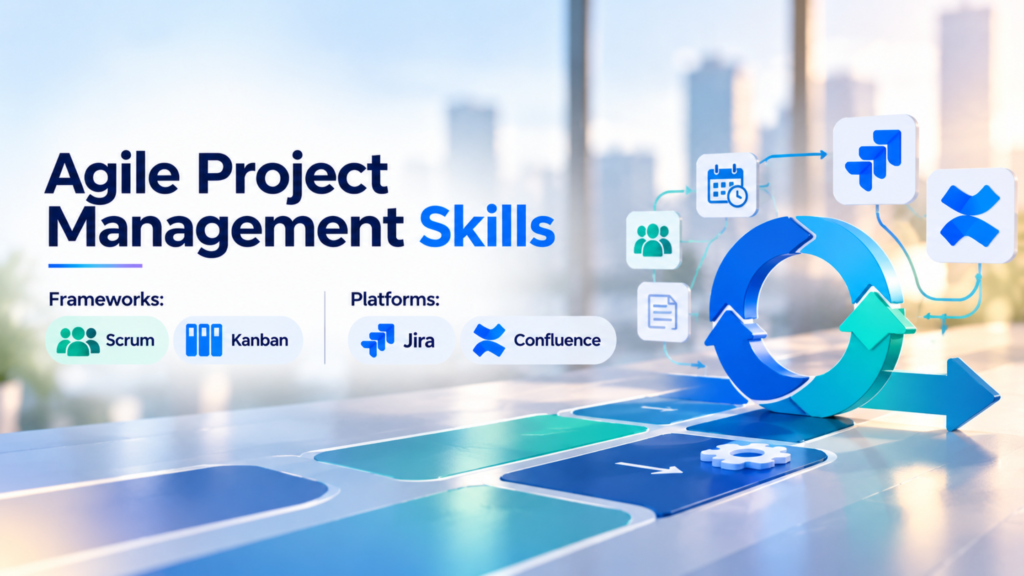
Popular frameworks such as Scrum and Kanban help organizations organize work, prioritize tasks, manage workloads, and improve visibility across teams. Modern Agile environments also make extensive use of collaboration platforms such as Atlassian Jira and Confluence to streamline project tracking, documentation, and communication.
The widely used tools Scrum, Kanban, Atlassian Jira, and Confluence are defined in the following.
Scrum
Scrum is an Agile project management framework that helps teams deliver work in short, iterative cycles called sprints. It promotes collaboration, continuous improvement, and the ability to adapt quickly to changing project requirements.
Kanban
Kanban is a workflow management method that visualizes tasks on a board to help teams organize work, manage priorities, and improve efficiency. It focuses on continuous delivery by limiting work in progress and optimizing workflow.
Atlassian Jira
Atlassian Jira is a project management and issue-tracking platform used to plan, assign, monitor, and manage software development and business projects. It supports Agile methodologies such as Scrum and Kanban, enabling teams to track progress and collaborate effectively.
Confluence
Confluence is a team collaboration and knowledge management platform developed by Atlassian. It allows teams to create, organize, share, and maintain documentation, project plans, meeting notes, and other important information in a centralized workspace.
Why Agile Project Management Matters Today
Today, digital transformation has changed how organizations operate. Projects no longer remain static from beginning to end. Customer expectations evolve quickly, technology advances continuously, and business priorities shift in response to market conditions.
With Agile Project Management, businesses remain competitive by allowing teams to respond quickly while maintaining focus on delivering value.
Companies use Agile to:
- Deliver products and services more quickly
- Respond to changing customer requirements
- Improve collaboration across departments
- Increase project visibility
- Reduce development risks
- Encourage continuous improvement
- Strengthen customer engagement
- Improve overall project success rates
Through Agile emphasis on continuous delivery and ongoing feedback throughout the project lifecycle, businesses thrive in the fast-paced industry world.
Benefits of Learning Agile Project Management
Greater Adaptability
Agile prepares professionals to manage changing priorities confidently while maintaining project momentum and business value.
Faster Project Delivery
Breaking projects into smaller iterations enables teams to deliver usable results sooner while continuously refining the final product.
Stronger Team Collaboration
Regular planning sessions, reviews, and daily communication improve coordination between project managers, developers, business analysts, stakeholders, and customers.
Better Customer Satisfaction
Customers remain involved throughout the project, allowing their feedback to shape future development and ensuring the final outcome better meets their expectations.
Higher Quality Results
Continuous testing, evaluation, and improvement reduce defects while increasing the quality of project deliverables.
Reduced Project Risks
Smaller development cycles help identify issues early, allowing teams to resolve challenges before they become costly problems.
Improved Productivity
Agile helps teams focus on the highest-priority work while reducing unnecessary activities that delay progress.
Valuable Career Opportunities
Organizations continue seeking Agile Project Managers, Scrum Masters, Product Owners, Business Analysts, Project Coordinators, Delivery Managers, and Technology Leaders who understand Agile methodologies and collaborative project delivery.
Agile is a vast and thorough tool for project and program management. It is that understanding Agile concepts is only the beginning. The real value comes from applying Agile principles to actual business projects.
In consequence of that, I hereby present to you Trainosys Training Services that delivers instructor-led Agile programs of which combine discussions, demonstrations, workshops, case studies, and hands-on exercises. Trainosys’ course participants learn practical project management techniques that can be implemented immediately in their organizations rather than focusing solely on theoretical concepts.
Trainosys’ Agile Project Management Training Courses
Agile Project Management with AI
Duration: 5 Days (35 Hours)
A comprehensive training program designed for project managers, product owners, Scrum Masters, business analysts, team leads, and professionals leading digital transformation initiatives. It combines Agile methodologies, including Scrum and Kanban, with practical applications of artificial intelligence to help teams plan, deliver, and continuously improve projects more efficiently.
Key Learning Objectives:
- Understand Agile principles, Scrum and Kanban frameworks, and apply the appropriate methodology to improve project delivery and team collaboration.
- Build product visions, user personas, roadmaps, and prioritized backlogs while applying customer-centric discovery techniques to align project outcomes with business goals.
- Utilize AI to enhance project planning, backlog refinement, estimation, risk identification, sprint planning, and decision-making throughout the Agile lifecycle.
- Facilitate Agile ceremonies, including Sprint Planning, Daily Scrum, Sprint Review, and Sprint Retrospective, using AI-assisted workflows to improve productivity and team performance.
- Develop an end-to-end Agile delivery plan by integrating Scrum, Kanban, AI tools, and industry best practices to deliver high-quality products with greater efficiency and continuous improvement.
Agile Project Management with Scrum and Traditional Project Management
Duration: 4 Days (28 Hours)
Targeted towards project managers, Scrum Masters, product owners, business analysts, team leaders, and professionals who want to master both predictive and Agile project delivery approaches. Provides a practical foundation in traditional project management while introducing Scrum principles, roles, events, and artifacts, enabling participants to determine the most suitable methodology based on project goals, complexity, risks, and changing business requirements.
Key Learning Objectives:
- Apply project management fundamentals, including project initiation, planning, scheduling, budgeting, stakeholder management, risk management, and project closure to deliver successful projects.
- Understand Agile values and Scrum principles, including Scrum roles, events, artifacts, and iterative delivery practices that improve collaboration and customer value.
- Develop and prioritize Product Backlogs, create user stories with acceptance criteria, and conduct Sprint Planning, Daily Scrum, Sprint Review, and Sprint Retrospective sessions effectively.
- Monitor project performance using both traditional and Agile techniques, including project status reporting, risk tracking, burndown charts, velocity, and continuous improvement practices.
- Evaluate project requirements and select the most appropriate delivery approach by applying traditional, Agile, or hybrid project management methodologies to achieve business objectives efficiently.
Agile Project Management with Scrum
Duration: 3 Days (21 Hours)
Aimed towards project managers, Scrum Masters, product owners, business analysts, team leaders, and professionals who want to deliver projects more effectively using Agile methodologies. Discusses the understanding of the Scrum framework, enabling participants to manage changing requirements, improve collaboration, and deliver high-value products through iterative development. On an additional note, course participants will learn how to create product backlogs, write effective user stories, facilitate Scrum events, estimate work, and monitor project progress using Agile metrics.
Key Learning Objectives:
- Understand Agile values, principles, and the Scrum framework, including Scrum roles, events, artifacts, and the Agile mindset required for successful project delivery.
- Create and prioritize Product Backlogs, write user stories with clear acceptance criteria, and develop Sprint Goals that align with business objectives.
- Plan and facilitate Scrum events such as Sprint Planning, Daily Scrum, Sprint Review, and Sprint Retrospective to improve collaboration and continuous delivery.
- Apply Agile estimation, prioritization, release planning, and progress tracking techniques using story points, velocity, burndown charts, and other Scrum metrics.
- Implement Scrum best practices to manage project risks, respond to changing requirements, improve team productivity, and deliver customer-focused solutions in dynamic business environments.
Agile Project Management with Kanban
Duration: 2 Days (14 Hours)
Designed for project managers, Scrum Masters, business analysts, team leaders, software developers, and professionals who want to improve project delivery through a flow-based Agile approach. Introduces the principles and practices of Kanban, helping participants visualize work, manage workflows, reduce bottlenecks, and deliver value continuously. Additionally, this course emphasizes adaptability, transparency, and continuous improvement, making it an ideal approach for teams operating in fast-changing business environments.
Key Learning Objectives:
- Understand Agile and Kanban principles, including how flow-based project management differs from traditional delivery approaches and supports continuous improvement.
- Design and implement Kanban boards that visualize workflows, improve transparency, and help teams manage work more effectively.
- Apply Kanban practices such as work-in-progress (WIP) limits, flow metrics, lead time, cycle time, and bottleneck analysis to optimize team performance.
- Use Lean concepts, value stream mapping, waste analysis, and Kaizen principles to identify improvement opportunities and increase operational efficiency.
- Develop practical Kanban implementation strategies that enhance collaboration, improve workflow predictability, and support continuous delivery across Agile project environments.
Effective Agile PM with Atlassian JIRA Confluence
Duration: 1 Day (7 Hours)
Crafted for project managers, Scrum Masters, product owners, business analysts, Agile team members, and technology leaders who want to manage Agile projects more effectively using Atlassian tools. Combines Agile project management principles with hands-on experience in Jira and Confluence, enabling participants to plan, track, collaborate, and document projects within a unified Agile workspace. Emphasizes collaboration, transparency, and continuous improvement, equipping participants with practical skills to manage Agile projects efficiently from planning through delivery.
Key Learning Objectives:
- Configure and manage Agile projects in Atlassian Jira by creating Scrum and Kanban boards, workflows, issues, epics, stories, and tasks that support efficient project execution.
- Plan and prioritize product backlogs, manage sprint activities, and monitor project progress using Jira dashboards, reports, burndown charts, and Agile metrics.
- Create, organize, and maintain project documentation, meeting notes, knowledge bases, and collaborative workspaces using Atlassian Confluence.
- Integrate Jira and Confluence to improve collaboration, project traceability, requirements management, and communication among Agile teams and stakeholders.
- Apply Agile project management best practices using Atlassian tools to improve team productivity, increase project visibility, and support continuous delivery in modern project environments.
Agile Project Management provides the framework that helps businesses become more responsive, collaborative, and customer-focused. It empowers professionals to manage projects with greater flexibility while maintaining quality, transparency, and accountability.
This vision closely aligns with the mission of Trainosys Training Services. Through practical instruction, expert facilitators, and industry-focused programs, Trainosys continues to prepare professionals and organizations for the future of work. Every course is designed to strengthen technical expertise, leadership capabilities, and collaborative skills that support long-term business success and digital transformation.
By combining Agile methodologies with artificial intelligence, automation, cloud technologies, business analysis, and digital transformation concepts, Trainosys ensures its learners develop skills that remain relevant in a rapidly changing business environment.
Elevate your Agile Project Management Now via [email protected]
For more IT and professional development programs, visit our website at www.trainosys.com